New Zealand & French Polynesia — Two extraordinary worlds
From New Zealand to French Polynesia: spectacular fjords, active volcanoes and Hobbiton on the North Island, then the turquoise waters of Bora Bora and Moorea. Two worlds at the opposite ends of the same ocean, united in one unforgettable journey.
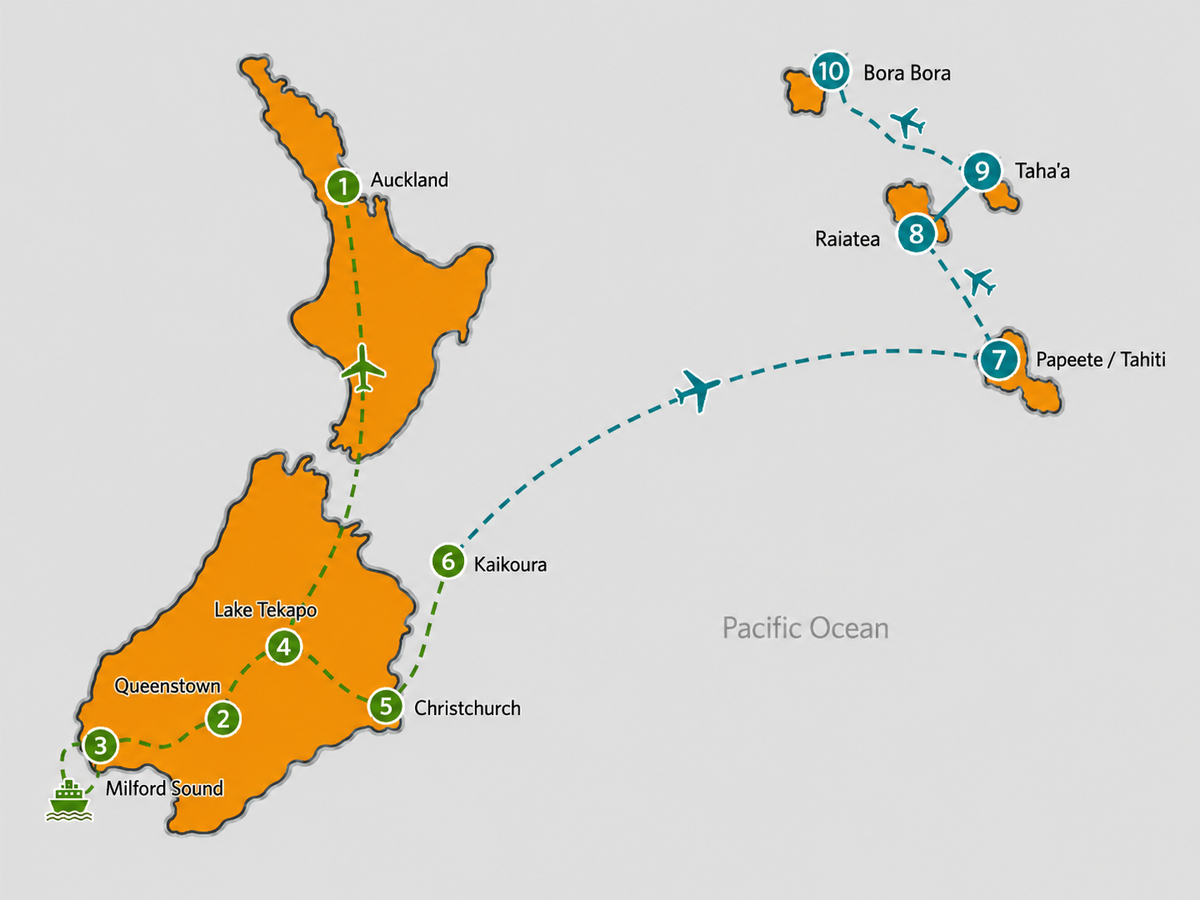
The Route
Day-by-Day Programme
Arrival in Auckland
Arrival in Auckland, the City of Sails, New Zealand's largest city with over 1.7 million inhabitants. Auckland sits on a volcanic isthmus between two harbours: Waitemata to the east (Pacific) and Manukau to the west (Tasman). Hotel transfer in the Viaduct Harbour quarter and first evening stroll along the marina among racing yachts and seafood restaurants.
Flight to Queenstown
Flight to Queenstown on the South Island. Landing at Queenstown is already spectacular: the runway sits at the edge of Lake Wakatipu and the plane seems to land on the water with the Remarkables mountains in the background. Queenstown is the world's adventure capital — bungee jumping, skydiving, jet boating, skiing — but also an elegant town with excellent restaurants and wineries. Hotel check-in with lake and mountain views.
Queenstown — lake and panoramas
Day in Queenstown: gondola to Bob's Peak (450m) with 360° views of Lake Wakatipu and the Remarkables Range. Cruise on the TSS Earnslaw steamship (built 1912) to Walter Peak Station, an authentic sheep farm on the lake's shores. Afternoon: jet boating on the Shotover River (optional) or wine tasting in Gibbston Valley, the valley of New Zealand's most award-winning pinot noirs.
Glenorchy and Lord of the Rings locations
Excursion to Glenorchy, 45 minutes from Queenstown along Lake Wakatipu. The road to Glenorchy is already a work of art: snow-capped mountains, red beech forests and the lake changing colour at every bend. Glenorchy and the Paradise Valley host many Lord of the Rings locations: Isengard, Lothlórien, Amon Hen. Walk in the Dart River Valley with a specialist film location guide. Picnic in one of the world's most beautiful landscapes.
Milford Sound
The most awaited day: transfer to Milford Sound through the UNESCO World Heritage Fiordland National Park. The Milford Road is one of the world's most scenic drives: it passes through the Homer Tunnel (1,270m through the mountain), the Eglinton Valley with its silver beech trees, Mirror Lakes where mountains perfectly reflect in the water. The fjord cruise lasts 2 hours: waterfalls plunging from hundreds of metres, New Zealand fur seals resting on rocks, sometimes dolphins and penguins.
Back through the South Island
Free morning at Milford Sound — if luck is on your side, the morning mist creates an even more mystical atmosphere in the fjord. Begin the drive east towards Tekapo through the South Island plains. Stop at the Lindis Pass (971m) — the ridge separating Otago from Canterbury — where in summer the hills are covered in golden tussock. Late afternoon arrival in Cromwell in Central Otago, famous for cherries, peaches and pinot noir.
Lake Tekapo and Aoraki/Mount Cook
Arrival at Lake Tekapo: the milky turquoise water is caused by 'glacial flour' — extremely fine rock particles suspended in the water that reflect sunlight in a unique way. The small Church of the Good Shepherd, built in 1935 in local stone with a window framing the lake and mountains, is one of New Zealand's most photographed scenes. Afternoon: transfer to Aoraki/Mount Cook Village to see up close Mount Cook (3,724m), New Zealand's highest mountain. Evening: stargazing in the Mackenzie Basin, one of the planet's darkest areas certified as an International Dark Sky Reserve.
Christchurch
Transfer to Christchurch, the South Island's garden city, rebuilding after the devastating 2011 earthquake that destroyed 70% of the city centre. Today Christchurch is a creative and courageous city: the Re:START Mall made of colourful containers, the cathedral under reconstruction, bold new architectural buildings like the Cardboard Cathedral. The Botanic Gardens and Hagley Park remain among New Zealand's finest. Flat-bottomed boat (punt) trip on the Avon River.
Kaikoura — whale watching
Transfer to Kaikoura along the coastal highway, one of New Zealand's most spectacular coastal roads: Tasman Sea to the west, snow-capped mountains to the east. Kaikoura is one of the few places on Earth where sperm whales (Physeter macrocephalus) can be seen year-round: the deep marine canyon offshore creates upwellings rich in giant squid — the sperm whale's favourite prey. Whales dive to depths of 2–3km and surface to breathe every 60–90 minutes. Boat tour (2 hours) with sighting guarantee.
Wellington — creative capital
Flight or Interislander ferry from Picton to Wellington, New Zealand's capital. The ferry crosses Cook Strait and then winds through the Marlborough Sounds — one of the world's most beautiful maritime landscapes. Wellington is small but vibrant: the Te Papa Tongarewa Museum (New Zealand's national museum, free entry), the cable car to Mount Victoria, the Cuba Street quarter with its bookshops, specialty coffee shops and galleries. Peter Jackson has his studio (Weta Workshop) right here.
Tongariro National Park
Transfer to Tongariro National Park, New Zealand's oldest national park (1887) and a dual UNESCO World Heritage site — both for natural and Maori cultural values. The park hosts three active volcanoes: Ruapehu (2,797m), Ngauruhoe (2,291m, the Mount Doom of Lord of the Rings) and Tongariro (1,978m). The Tongariro Alpine Crossing (19.4km, 7–8 hours) is considered New Zealand's best single-day hike: it follows the volcanic ridge through steaming craters, emerald lakes and lunar landscapes.
Rotorua — geothermal and Maori
Rotorua is unique in the world: a city built above an active geothermal field where the ground breathes — sulphurous steam rises from manholes, gardens and the lake shores. Visit Te Puia, the city's most important geothermal site, with the Pohutu geysers (the largest in the southern hemisphere at 30 metres) and the National Maori Arts School, where traditional wood carving and weaving are taught. Then Wai-O-Tapu, the most colourful geothermal site: the Champagne Pool (CO2 bubbles in 74°C water), the Devil's Bath (lime yellow from sulphur) and the boiling mud pools. Evening: Maori cultural show with haka and traditional hangi.
Hobbiton
The moment Tolkien fans have been waiting for: visit to the Alexander Family Farm in Matamata, where Peter Jackson built the original 44 Hobbit Holes for The Lord of the Rings (2001–2003) and kept the location intact for The Hobbit (2012–2014). The farm was chosen after Jackson's helicopter flyover in 1998: the gentle green hills, the pond and the ancient oak seemed straight out of Tolkien's illustrations. 2-hour guided tour in costume among the coloured round doors, flower gardens, the Mill and the Green Dragon Inn (aperitif included).
Waitomo Caves
Waitomo Caves are one of New Zealand's most extraordinary natural experiences. The boat ride in total darkness passes under a limestone ceiling where millions of Arachnocampa luminosa live — a New Zealand endemic insect whose larva emits blue-green light to attract prey. The result is an underground starry sky of unreal scale, in total silence. After the caves, transfer towards Auckland through the Waikato region.
Auckland — flight to Papeete
Arrival in Auckland and half a day to see the city: Sky Tower (328m, the tallest in the southern hemisphere), walk along Ponsonby Road with its cafés and restaurants, or a visit to Auckland Museum in the Domain. Afternoon hotel check-in near the airport. Night flight to Papeete (Tahiti) arriving early morning: crossing the Pacific at night, nothing but ocean and stars outside the window.
Arrival in Papeete — Tahiti
Early morning arrival in Papeete. Hotel transfer and rest day to adjust to the time zone change (French Polynesia is 2 hours behind New Zealand). Afternoon first walk along the Papeete waterfront and market visit. Free evening in the Polynesian capital — the contrast with New Zealand is total: from snow-capped mountains to tropical lagoons.
Moorea — Cook Bay and Opunohu Bay
Ferry to Moorea (20 minutes from Papeete). Resort check-in and first contact with the Polynesian lagoon — after New Zealand's green and mountainous landscapes, Moorea's turquoise water is a visual shock in the best sense. Afternoon island exploration: Cook Bay with its volcanic mountains reflected in dark green water, Opunohu Bay with its mango and noni hills, climb to the Belvedere for the island panorama. Resort dinner at sunset.
Moorea — rays and dolphins
Boat excursion in Moorea's waters to swim with giant manta rays: these animals with a wingspan up to 5 metres filter plankton just below the surface, accustomed to human presence. Then into the channel between Moorea and Tahiti in search of spinner dolphins and common dolphins — they often approach vessels to play in the bow waves. Afternoon snorkelling in the resort lagoon: black-spotted stingrays (Himantura fai) and turtles approach easily.
Moorea — free day
Free day on Moorea. Those who want to explore can rent a quad or bicycle to tour the island, stopping at the Saint-James rum distillery. Those who prefer to relax: the water in front of the resort is shallow, crystal-clear and full of life — baby stingrays often forage in the sand along the shore. Black pearl shopping at the boutiques of Vaiare harbour.
Flight to Bora Bora
Flight from Moorea (via Papeete) to Bora Bora. Landing on the atoll is one of the world's most beautiful flight experiences: the runway is on a flat motu surrounded by the lagoon, Mount Otemanu rises in the background and the water around the plane changes colour as you land. Speedboat transfer to the resort. The first Bora Bora evening, on the overwater bungalow terrace, the sunset turns Mount Otemanu orange and pink.
Bora Bora — lagoon and snorkelling
Lagoon excursion: coral gardens with tropical fish, snorkelling with manta rays and reef sharks (blacktip and whitetip, entirely harmless), stop on a private motu with the finest white sand beach for lunch. Bora Bora's lagoon is protected by an outer coral reef creating a calm and transparent inner basin — you can see the bottom even at 10–12 metres depth.
Bora Bora — free day
Completely free day: Bora Bora offers everything you could want from a tropical paradise. Swimming from the bungalow pier (often fish here too), kayaking on the lagoon, paddleboard lesson, jet skiing, helicopter tour over the atoll or simply total relaxation on the chaise-longue above the water. Traditional Polynesian outdoor massage with Otemanu views.
Last day in Bora Bora
Last morning on the Bora Bora lagoon. Final shopping for black pearls and souvenirs in Vaitape. Last resort lunch with Otemanu views. Afternoon speedboat transfer to the airport and flight to Papeete for the intercontinental return connection.
Departure — End of Journey
Flight from Papeete via Los Angeles to your destination. A journey that has touched two of the planet's most spectacular natural worlds: the fjords, volcanoes and forests of Aotearoa on one side, the blue lagoons and giant manta rays of French Polynesia on the other. End of an adventure that leaves a mark.
What's Included
- Accommodation in selected 4★/5★ hotels and overwater resorts
- Breakfast included at all hotels
- Car hire Queenstown → Franz Josef → Nelson
- Guided tours: Waitomo, Hobbiton, Milford Sound
- Franz Josef Glacier heli-hike
- Papeete → Bora Bora → Moorea domestic flights
- Bora Bora lagoon excursion with lunch
- All local airport transfers
Not Included
- International and domestic flights
- Travel insurance
- Anything not expressly listed in the included services
From
US$11,290
per person · land services · indicative price, subject to change
Want to customise this itinerary? Contact us for a tailored quote.
Contact Us